
Analyze
When I was in my 20s, I spent a lot of my time in nonprofit offices, figuring out their challenges, facilitating strategic planning, or discussing fundraising strategies. I liked to ask executive directors, “who are your competitors?”
The answer was always the same “Oh, we don’t have competitors” OR “Oh I don’t really know.” Nonprofits are too nice.
It’s ok to acknowledge that you compete for the same dollars and that there are things that make you better than your competition. It’s even better to get specific.
What makes your organization compelling? It’s four things.
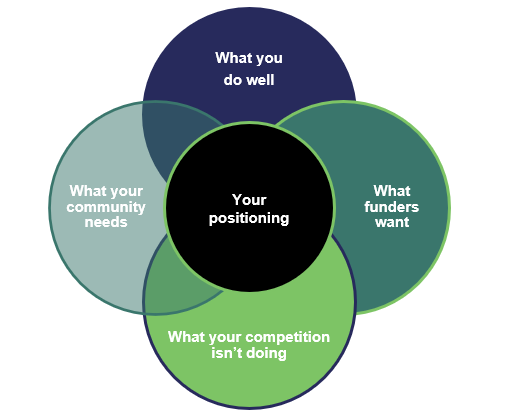
1. What you do well
Everyone can say they provide 'evidence-based mental health services.' That means nothing.
What you need is something like: 'We use peer-led navigation where people with lived experience of mental health challenges deliver services. Our data shows 3x higher engagement rates and 78% appointment adherence compared to 24% with traditional clinical outreach.'
Specific and measurable. Impossible for a competitor to copy-paste.
2. What funders want
You might do amazing work, but if funders are going in a different direction, you're running the steeplechase (look it up!), while everyone else gets to stay dry.
Look at donor 990s. Read their annual reports. Pay attention to their language.
If every foundation in health equity is talking about 'community-driven solutions' and 'centering lived experience,' but your model is clinical and provider-led, you have a positioning problem.
You can either reframe your work to show how it aligns with what funders want, or find different funders who value what you actually do. Both are valid strategies. What doesn't work is ignoring what funders care about.
3. What your competition isn’t doing
When I was at RTI, our major health governance competi-peer focused heavily on online training, tools, and cross-country cohorts.
We went the other direction. Bespoke models, strong political economy analysis, and in-depth expert analysis and advice. That approach didn’t scale quite as well, but we didn’t want scale. We wanted impact.
Zig when others zag, I say. Fill a gap. Find your niche.
4. What your community needs
I mentioned political economy analysis earlier: that’s one way to identify your community needs, and the drivers behind the challenges your community faces. Being able to say that you analyzed the data, talked to people, and understand not just how things work, but WHY they work, is often the difference between a credible, winning proposal, and one that doesn’t quite get across the finish line.
This isn’t a proposal story, but it’s indicative. I once launched a project thinking I was building an IT solution to help a government agency better manage its workflow. I was wrong. After talking to the community they served, I realized that the problem wasn’t a technology one, it was trust. So we pivoted the project to support trust building between the agency and their clients, driving service usage from 1 or 2 cases a month to dozens.
ANALYZE isn't about writing your mission statement better or more clearly. It's about an honest self, community, donor, and competitive assessments. What do we do better than anyone else? What do funders actually care about right now? What gaps exist in how our competitors serve communities? What does our community need that they're not getting?
Next up: REVEAL. How do you find funders who actually care about that difference?
