
What's New in September
Welcome to your September Cadence Advisory newsletter. This month, we have organizations accepting and rejecting bucket loads of cash, foundations making big bets on infectious diseases, and Rural Health Transformation Project allocations that don’t align with rural health. Take a journey with me through the things that I cared about this month.
What We're Interested In
1) Despite complaining about American NGOs and multilaterals in 2025, the State Department will…mostly fund NGOs and multilaterals in 2026.
I asked in August if State would figure out how to move money to local organizations. And then, at the beginning of August, the administration announced nearly $2 billion in global health funding for three faith-based American NGOs: World Vision, Catholic Relief Services, and Compassion International. Reporting has suggested that this funding came through repeated engagement with the White House Faith Office, rather than through traditional procurement. Setting aside my concerns about sole-sourcing, I was at least pleased to see that some global health money was expected to flow the State Department. And then….Samaritan's Purse turned down their $300 million portion of the funding on August 28. Franklin Graham told Devex the organization has "always relied on God, not government, for funding."
So where does that leave the broader sector?
Clearly funding is being directed, rather than awarded (the Advancing Global Health APS notwithstanding). But why the funding rules weren’t negotiated between State and Samaritans Purse before the announcement is beyond me. It’s a strange state of affairs, but there’s lots about the current environment that’s strange. In any case, expect to see more global health organizations focusing their business development work at the Eisenhower Executive Office Building, and not in Foggy Bottom.
2) GiveWell in my newsletter, again!
Just last month, I talked a bit about all the new money available for effective altruism-aligned organizations. Now we know what at least one of them will do with it…
GiveWell announced its largest grant ever on August 24, $276 million to the Against Malaria Foundation. The money will buy and distribute 92 million insecticide-treated nets through the Against Malaria Foundation across all 26 provinces of the DRC between 2027 and 2029, and GiveWell believes 46 million of those nets wouldn't otherwise be distributed. They estimate that roughly 67,000 deaths will be averted.
I started up, and then managed, a malaria data project in DRC for two years. It is both a very expensive and difficult place to work. Here’s what I like: They put a lot of effort into figuring out the best mechanisms for delivery: commissioned household interviews and a national survey analysis to decide to fund shortened campaign cycles. It makes my project on optimizing scarce resources look silly, by asking the question we all wish we could answer, “what if resources for important things were not actually scarce?”
Here’s something I’d like to know: Why $276 million on just bed nets? There are so many effective malaria interventions: seasonal malaria chemoprophylaxis, malaria in pregnancy interventions, surveillance, spraying, and on and on and on. As my former colleague Benjamin Binagwa asked in the comments, “While LLNs are good, we need to establish habitat infrastructure and behavioral issues related to net use. Otherwise, that amount of money invested in other areas would bring long lasting impact.” I agree and I hope that the headline is papering over some critical details.
3) Rural health. But not for rural states.
The Rural Health Transformation Program is roaring, with states issuing RFAs in workforce, digital health, behavioral health, and innovative financing. The turnaround time on the opportunities from states average 31 days, based on my analysis of the 288 awards that have been announced. Preparation is vital. Check the NRHA’s tracker for updates on what opportunities are anticipated and what are in review.
Maybe I’ll do a deeper dive into these awards in October. There’s so much information in the NRHA’s dataset on technical areas of focus and which states are moving money, that it’s probably worth a broader sweep.
One excellent analysis from the Kaiser Family Foundation showed that while first-year awards to states averaged $200 million, running from $147 million in New Jersey to $281 million in Texas, on a per capita basis, the LEAST rural states are doing better under the RHTP. Texas has the largest rural population in the country and gets $66 per rural resident. Rhode Island gets $6,305 and New Jersey gets $1,069, while 10 states (including my home state of Tennessee), receive under $100. The formula gives each state a baseline of $100 million each, followed by 25% aligned with need, and then just 5% ties to rural population. Rural organizations in big states, therefore, compete for limited per-capita dollars, while states with almost no rural population (looking at you Rhode Island…) figure out what to do with a windfall.
Funding Opportunities
Global Health
CDC Global Health Security NOFOs. Deadline October 2, 2026, posted on Grants.gov as CDC-RFA-JG-26-0052 and CDC-RFA-JG-26-0053. These fund partnerships with Ministries of Health on surveillance and reporting, laboratory systems, workforce development, emergency management, and service delivery. CDC finally published these RFAs that had been forecasted for over a year. Given that these procurements are operating via competitive procurements, with published criteria, while State is doing sole-sourced awards, these can be worth the effort even for the small amounts of money and the compliance burden.
New Venture Fund for Global Health Agencies and Funds. Rolling, up to $250,000, global. Small and nimble project grants for health systems strengthening, coordination across global health agencies, and equitable access to products. Does your organization already work alongside a multilateral organization like WHO, UNICEF, the Global Fund, the Pandemic Fund, the Global Financing Facility, or Unitaid? Consider applying, as they accept unsolicited requests through nvfghaf@newventurefund.org.
Domestic Social Services
Virginia Health Care Foundation Health Safety Net Grants. Rolling, $26,843 to $388,706. Funds community health centers, free and charitable clinics, and other safety net providers on primary medical, behavioral, and dental care plus Medicaid and FAMIS outreach. A useful model of what state health foundations are funding as Medicaid pressure lands on safety net budgets.
Morris and Gwendolyn Cafritz Foundation. Deadline November 1, 2026, $10,000 to $125,000, for organizations serving DC, Prince George's and Montgomery Counties, Arlington and Fairfax Counties, Alexandria, and Falls Church. The Foundation states a preference for general operating support whenever possible. DC-area organizations that need unrestricted funding and have a good story should consider this opportunity.
Campbell Foundation Unsolicited Grant Program. Deadline January 29, 2027, $5,000 to $25,000, two cycles a year. Small funding, but general operating support is scarce. Organizations working on agriculture, clean and safe drinking water, community engagement, and watershed advocacy, with priority counties in California, Maryland, and Pennsylvania. These are small checks, but they are unrestricted and they accept unsolicited requests.
Foundation of the Month
Nick Simons Foundation (New York, New York). Here’s a new one to me (thanks Kindora!). This foundation holds $223.7 million in assets and has made 66 grants into Nepal totaling $14.8 million.
Grantmaking fell 56.8% between 2023 and 2025, from $14.3 million to $6.2 million, while assets held roughly flat at $223.7 million. Given that assets remained the same, this seems like part of a plan, rather than a reduction in capability.
Gradian Health Systems received $8.5 million in 2025 for medical equipment in low-resource hospitals, on top of multiple prior awards. Nick Simons Foundation International received $5.26 million in 2025 as program and general operating support for the Nick Simons Institute in Nepal, its own affiliated organization. Patan Hospital, Nyaya Health Nepal, and Autism Care Nepal make up most of the rest, with grants from $500,000 to $1.1 million. The foundation has made 40 expenditure responsibility grants worth $26.4 million; they are truly giving money outside the United States to organizations that do not have fiscal sponsors.
Nick Simons gives significant funding to Nepali hospitals and Nepali organizations. It's also pretty much a closed shop. Two anchor grantees and an affiliated institute absorb most of the giving and there's no open call. Do you work in Nepal on hospital services, nursing education, or rural health delivery, like One Heart Worldwide (one of my former partners)? Worth trying to make a connection.
If you don’t, go elsewhere…but recognize how common this model is.
What’s New in August
Welcome to the first iteration of Cadence Advisory's newsletter.
Each month, I'll drop a few hundred words on the current nonprofit funding landscape, including global health and development and US-based social services, along with anything I find interesting coming out of my ongoing work.
I'll also provide a few open calls I'm tracking, funder profiles, and some tools, processes, or workflows I'm finding especially promising.
If you don't want to receive updates from me, no worries, I promise not to be offended! There's an unsubscribe button at the bottom of this email.
What We're Interested In
What's new in August? I'm tracking three big pieces of news.
1) The ongoing mystery that is the State Department. Devex quotes the current head of the Global Health Security and Diplomacy Bureau, Jeffery Graham, as saying that State wants more diverse contractors, including local NGOs. Yet every award I've seen is a sole source to an international NGO or an extension of a legacy USAID award. Will the State Department figure out how to get money to local organizations? I'm personally optimistic, but not hopeful.
2) What's new in philanthropy? That sound is the return of the randomistas and the GiveWell-ification of the entire space. Coefficient Giving recently announced a $1 billion donation to GiveWell, unsurprising given the institutional connections between the two. In my career, I've mostly worked on things that couldn't be well measured (how does one attribute health outcomes to improved meeting processes?). For years, I welcomed this way of thinking to the discussion, including giving money to GiveWell and GiveDirectly, as a bulwark against my biases. And yet, it feels like the pendulum has completely swung that direction, and away from governance, financing, and data systems. If only we'd figured out the cost-effectiveness of citizen engagement in 2015 like we wanted to...
3) Rural health marches on. Pennsylvania recently announced that they were limiting competition on their EHR funding to Federally Qualified Health Centers (FQHCs). FQHCs have broad appeal and bipartisan support, with clear rules and requirements, so while these set-asides aren't surprising, it's the first one I've seen. FQHCs, not nonprofits, will likely be the big winners of RHTP funding, while Medicaid cuts harm their bottom line from a different side. Navigating a new funding mix is never easy. Arizona is the next one of these I'm tracking, with about $40 million in the pipeline to drive innovative care and financing, likely to figure out how to absorb Medicaid cuts.
Anticipated Funding Opportunities
Global Health
Butterfield Memorial Foundation's International Whole Person Healthcare grant. Deadline August 15, 2026, an LOI process posted through Butterfield's grant portal. Funds Christian nonprofit organizations expanding healthcare access for underserved international populations, including indigenous communities. Organizations with a faith-based identity and an active international health program have a real, near-term shot at this one.
Domestic Health
Pennsylvania's FQHC EHR set-aside. $1.8 million total, capped at $300,000 per organization, funds Federally Qualified Health Centers and FQHC Look-Alikes adopting certified electronic health record systems and joining the state's health information exchange, per Pennsylvania DHS. More states will roll out RHTP set-asides like this one, and FQHCs need help identifying and applying for them as they land.
Title X Family Planning Services Grants. Deadline January 9, 2027, posted on Grants.gov. Recurring federal funding for family planning services, open to a wide range of health and human services providers. Title X has held steady through multiple administrations, which makes it a dependable base for clients building a broader funding strategy around reproductive and family health.
Domestic Social Services
Start Small LLC. Jack Dorsey's philanthropic vehicle, startsmall.llc, funds general operating support and program grants from $25,000 up into eight figures, with a focus on girls' health and education, universal basic income, and community services. It accepts unsolicited funding requests, and past grants have gone to community organizations with no prior relationship to Dorsey. Even one of the largest individual donors in the country is backing unrestricted, operational funding over tightly scoped project grants, which is a major shift toward recognizing the actual needs of nonprofits.
Foundation of the Month
Segal Family Foundation (Warren, New Jersey). This family foundation holds $118 million in assets and has made 645 international grants across 25 countries, concentrated heavily in East Africa. Kenya, Uganda, Tanzania, Malawi, and Rwanda account for the bulk of their giving, both by dollar amount and by number of grants.
Their grantmaking dropped 43% between 2023 and 2025, from $22.9 million to $13 million. Know that before you approach them with an ask sized to their old giving level.
Recent grants include $204,000 to Fundi Bots in Uganda for STEM education, $110,000 to Lwala Community Alliance for community health work in Kenya, and $115,000 to Gardens for Health International for nutrition programming in Rwanda. The median grant lands around $100,000, and it goes almost entirely to locally led, grassroots organizations working directly in the countries they serve.
Segal is a foundation to know if your organization is led from, and works in, East Africa. If you're a US-based organization implementing through partners on the ground, look elsewhere first. Ask yourself who actually runs your programs day to day, and where do they live? Segal wants that answer to be a name and a place.
Poetry rhymes
The State Department’s new global health addendums are familiar. Here are four new things to look for anyway.
I love Star Wars. I was a kid in the 1980s and to a kid there’s nothing better than laser swords and spaceships. While talking about the prequel trilogy, George Lucas once said: “It's like poetry, they rhyme. Every stanza kind of rhymes with the last one.” This quote was mocked heavily at the time. Especially once my generation decided in our 20s that the prequel trilogy was bad, actually.
Yet, the kids that saw the prequel trilogy in the theatre were filled with wonder; they grew up and loved a part of the franchise that didn’t speak to me anymore. And that was…fine.
Last week, we finally saw the future of US-backed bilateral global health assistance as the Department of State released addendums in Nigeria, Uganda, and Malawi. And, as George Lucas would say, they rhyme. There’s a lot familiar here: digital health, supply chain, sustainability, localization, G2G, even health center electrification!
But rhyming is not copying. There are distinct differences between the “original trilogy” and what comes next. Let’s talk about four of them.
Faith- and community-based services
Going back to my work at the beginning of PEPFAR, I have a strong affinity for faith-based community and health services, not because I believe that faith inherently produces better results, but because it’s a natural builder of community and trust. The FBOs that I’ve worked with have been well organized, community grounded, and capable delivery partners. Secular organizations can build community; it’s just an order of magnitude more difficult. Unironically, there’s a similar dynamic with gay rights organizations.
Faith-based services are embedded in the program design in a way that I’ve not seen before, even under the second Bush administration. In Uganda, three of the eight objectives address FBOs, including financial sustainability and institutional capacity. The Nigeria addendum specifically EXCLUDES support to government-run facilities, rather faith-based hospitals and clinics are the delivery mechanism. Malawi's guiding principles name FBO and community stakeholders as priority implementation partners.
This shift represents both opportunities and threats. The APS mechanism, the number of anticipated awards, and the ability to bid on only one objective in all three countries clearly signals that the State Department will issue more and smaller awards, which allows local faith-based and community-based organizations to compete as primes.
While USAID’s procurement architecture historically rewarded large primes with global compliance infrastructure, these addendums reward organizations with embedded community trust, existing service delivery networks, and governance structures capable of absorbing direct financing. It remains to be seen if the DOS will follow through on this thinking with flexible contract terms and financing, cost-reimbursable mechanisms have always been a challenge for local organizations.
Finally, given their limited staffing on oversight, management, and contracting functions, I don't know if the Department of State can execute and manage the number of anticipated awards under this mechanism.
Transition is the program, not a principle
These awards will be explicitly measured based on the ability of grantees to transition support to non-USG-financed mechanisms by 2030. For example, Nigeria specifies a 25% annual reduction in USG salary support beginning 2027, with full GON absorption by 2030.
That is not something a grantee can control. I've often used the example of the blood bank in Kenya, where USG tried to transition control and financing to the Kenyan government, gave them ample warning, and still the blood bank collapsed when it was transitioned, costing innumerable lives.
And anyway, governments like Nigeria have a more basic set of concerns. One thing I learned from my time working on governance projects: the most important function of a state is to have a monopoly on violence. The Nigerian government certainly does not, especially in the north. In many ways, they are better off spending more money on guns than butter, so good luck convincing them to pay for more nurses.
Until this sort of rapid transition from USG or other donor support happens in real life, and not a budget line here or $80,000 there, I’m skeptical that it’s possible.
The addendums also disqualify interventions that create parallel structures (hint hint HIV implementers). Rather than this being a vague guiding principle, this is a review criterion. Transition is easier to say than do, but it is, at least, directionally correct to embed more fully in program design than implementers scrambling for sustainability in the last year of a five year award.
The APS rewards innovation
The APS mechanism is not one that we've seen very often in global health. At least not one that I've seen. I've only worked on a few APSs in my career. In my experience, USAID used them mostly to engage local organizations, to identify new players, and to get applicant-driven design. It signals that the State Department didn't really know what it wanted yet. But…it's also entirely possible they just used the APS mechanism because they didn't have the capacity to issue a bunch of NOFOs.
This provides a new set of benefits and drawbacks. For organizations that have operated at the margins of USG funding, who might understand how USG operates but have had trouble designing programs that specifically address every nook and cranny of a USAID NOFO, this mechanism presents an enormous opportunity to present new and interesting ideas. (This was exactly the premise of the Unlock AID consortium.)
For organizations that are used to a compliance-first mentality, where you must hit every single objective and guiding principle in a five-page concept note via keywords signaling, this is a new way of thinking and operating. That approach should be left in the past.
The goal of your SOI isn’t to win funding, it’s to move onto the next round. You move onto the next round by catching the reviewers' attention while remaining credible. I often say compliance first, then be compelling, but I think that way of thinking is backwards for these addendums. When I've done concept notes in the past, there was always a tension between trying to be comprehensive versus trying to be interesting. And we almost always leaned toward comprehensive. My advice: Be interesting.
The challenge, of course, is that genuinely novel approaches have significant implementation risk, especially over a five-year timeline with a hard transition deadline. SOIs will have to thread that needle by proposing approaches new enough to stand out and proven enough to survive transition by 2030.
AFGHS is the subtext, not the text
Do you notice four words missing from the addendums? "Safer, stronger, more prosperous."
The overviews, executive summaries, and program descriptions are quite technocratic. They talk about outcomes and specific diseases. They talk about government partnerships and MOUs. They talk about transition and country ownership.
This, I believe, will be a major sticking point. It's easy to think of these addendums as being business as usual, with more focus on FBOs and transition, based on the objectives and guiding principles. I think that’s a misreading. Remember that these decisions will not be made by career staff. They will be made by political appointees. Winning proposals must highlight America First Global Health Strategies fluently, not just repeat the words. That’s true, despite them not being explicitly named in the addendums.
The upshot
For the most part, this is less money spread across more awards than pre-2025. Nigeria, for example, is getting $200 million, but the Palladium-led IDIQ that it's replacing was $500 million. Some of that gap is in G2G awards. Some of it is just less available funding generally.
These addendums are not built for the big implementers. The barrier to entry is low. The awards will be small. The competition will be significant. Compliance is less important than compelling, at least at the SOI stage.
Rhyming is not copying. While these addenda may look familiar to anyone who's worked in health systems and services, the thinking behind them is not the same. There’s a lot new in here. Business as usual won’t work and the days of spending $200,000 worth of staff time on a five-page concept note are over.
As Admiral Ackbar would say, “It’s a trap!” If we use fresh eyes to review these addendums, rather than leaning too heavily on our vast USAID experience, we may be able to see our way out of the trap.
Hone
You've submitted a proposal! Congratulations! On to the next one, right?

I apologize for this aside into Millennial culture. But hopefully this will remind you to do After Action Reviews (and use the findings!)
Cue Michael Scott from The Office: 'No! God! Please! Noooooooo!!'
(Sorry. I'm a Millennial, or maybe Gen X. I don't really know.)
But seriously: Stop. Take a moment. Learn something.
This is HONE. The fourth and final step of the ARCH model. And it's the step most organizations skip entirely.
At RTI, I fought for After Action Reviews on every major proposal.
Win or lose, we’d gathered the team to ask four questions.
What was supposed to happen? (What was our strategy going in?) What actually happened? (Reality vs. our plan)
Why was there a difference? (Honest analysis of what went right or wrong) What will we do differently? (Actionable changes for next time)
I remember one bid in that we lost. The loss letter was complimentary. Very few negative comments about our technical approach. But the winner had an entirely local team. Including a bunch of organizations that I'd met with during our research phase.
We'd considered more local partnerships, but ended up emphasizing international best practices and technical expertise over local knowledge.
The After Action Review
What was supposed to happen: We'd win based on our technical expertise.
What actually happened: The funder chose a much more local team.
Why the difference: We had expertise but didn't demonstrate local partnership or leadership.
What we changed: For country-specific RFPs, we'd exhaust local partnership possibilities before turning to international expertise. Make local organizations partners from day one.
HONE isn't about massive transformations.
It's about getting a little better after every proposal. Better at understanding funder needs, explaining HOW you execute, and positioning your differentiators.
Those improvements, those iterations and adaptations compound.
One idea that I never got to implement in my health systems work is micro evaluations to drive program adaptation.
I do that now with HONE. Instead of on programs, I do it on proposals.
After Action Reviews aren’t complicated
Just spend two hours with your proposal team. Schedule one hour right after submission and another right after the decision.
Do your best to answer the four questions honestly: What was supposed to happen? What actually happened? Why was there a difference? What will we do differently?
Document what you learn, put it in the proposal folder, share the findings, combine insights from other AARs.
Build your institutional knowledge and stop making the same mistakes.
Final thoughts on this series
Growth isn't a sprint. It's a marathon. High quality processes, whether getting out the door every day for a run or describing “How?” every time, leads to strong outcomes.
ANALYZE. What makes you different.
REVEAL. Aligned funders.
CRAFT. Proposals that show HOW.
HONE. Every proposal.
These are the processes that lead to wins.
Ok, actual final thoughts
Last week, my friend’s dad died of a stroke. If you are a runner, you knew him. Jeff Galloway.
Jeff was a pioneer of process. He knew how to modify a training cycle to help people achieve their goals. As long as you followed through on the plan, he was going to get you across the finish line.
He loved the process. His peers would tell stories of how he never missed a workout and would record each one meticulously in a notebook.
In fact, he loved the process so much that he was training to run the Honolulu Marathon last December at 80 years old before a knee injury sidelined him.
You don’t have to love the process of running, or growth and development, as much as Jeff did to be successful.
But the run/walk method still helped tens of thousands of people accomplish their goals. RIP Jeff.
Craft
Years ago, I took on a new role. One of my first tasks: Read through our organization's old proposals to understand how we positioned our work.
I sat down with a stack of paper (Yes, I printed them out).
And I found myself writing the same question in the margins. 'How?'
'We will train community health workers.' How?
'We will strengthen health systems.' How?
'We will build local capacity.' How?
The proposals were full of great ideas. Good capabilities, good examples, impact. But when it came to implementation? Handwaving.

Proposal writing is a lot like crafting. Only you’re less likely to burn yourself with hot glue.
This is where most proposals fail. At HOW.
Most proposals read like activity lists. Train 50 CHWs. Conduct 200 home visits. Serve 1,000 families. Improve health outcomes.
That tells a funder WHAT you'll do. It doesn't tell them HOW you'll actually do it.
I get it. It's hard. It's so much easier to write 'we will train community health workers' than to dig into the specifics. What training format? (One week intensive workshop? Monthly sessions? Self-paced?) Who delivers the training? (Clinical officer? External consultant? Peer trainers?) What's covered? (Specific topics, tools, job aids?) How do you ensure quality? (Mentoring visits? Competency assessments? Refresher courses?)
Getting specific is hard work. But it's the difference between proposals that win and proposals that don't.
Here's an example of the HOW that funders need. 'We will train 50 CHWs to provide emergency care and hospital referrals in an experiential one-week course, using mannequins and models to practice skills, led by our Clinical Officer who has 15 years of field experience. Topics include bleeding control, stabilization, safe transport using locally available materials, and proper use of emergency first aid kits. Our Clinical Officer will conduct quarterly mentoring visits with each CHW to observe quality of care, troubleshoot challenges, and provide refresher training.'
See what that does?
Training format: One-week intensive, experiential with mannequins. Who delivers it: Clinical Officer with 15 years experience. What's covered: Specific topics (bleeding control, stabilization, transport, equipment). Quality mechanisms: Quarterly mentoring visits, observation, troubleshooting, refresher training.
When you explain HOW in detail, you demonstrate that you've done this before. You know the implementation challenges. You've thought through solutions. You have the expertise to execute.
Funders aren't looking for good ideas.
They're looking for organizations that know HOW to turn ideas into impact. Confidence is what they're buying. And confidence comes from specificity.
For every major activity in your proposal, answer:
How is the work structured? (Intensive training vs. ongoing workshops vs. one-on-one mentoring)
Who? Who executes this? What qualifications do they have?
What? Specifically is covered? What tools or curricula are used?
Results? How do you ensure it's done well? What metrics and oversight exists? How do you adjust when challenges arise?
If you can't answer these questions, you're not ready to write the proposal. If you can answer them, your proposal just became stronger than 80% of your competition.
I still do this when I write proposals.
I read through my own writing and put 'How?' next to every vague statement. 'We will provide comprehensive support.' How? 'We will use evidence-based approaches.' How? 'We will collaborate with community partners.' How?
Winning proposals don't make the reviewer ask.
CRAFT is the third step of ARCH.
It's where you take everything you've learned from ANALYZE (your differentiation) and REVEAL (funder alignment) and show HOW you'll execute. In confidence-building detail.
Because funders pay for ability to execute, not vague promises.
Reveal
A couple weeks ago, I saw an RFP looking for a grant writer to apply for 30 RFPs a month.
Thirty. A month.
I don't know what business they were in, but those responses were completely written by AI with zero donor or client specificity and they weren't getting funded.
This is the opposite of REVEAL. The second step in the ARCH model. The key to REVEAL is alignment.
Alignment between your organization, the donor or funder, and what they're trying to accomplish with their support.
I use systematic tools to clarify alignment possibilities: foundation spreadsheets with a simple three tier alignment, qualification scorecards to identify fit, and AI tools to extract meaning from disparate grants.
My philosophy: It's better to submit 2 high-quality, well-aligned grants than 5 mediocre ones.
Let me show you a simple example.
Let's say you run a peer-led health navigation program for homeless people.
Your differentiator, identified under ANALYZE, is that your services are delivered by people with lived experience, and your data shows 3x higher engagement than traditional clinical models.
You see RFPs from two foundations:
Foundation A. Requests outreach services to homeless populations. The foundation has typically funded facility-based services, with past grantees including FQHCs, hospital systems, and academic medical centers. Language in their RFP: 'clinical interventions.' Average grant: $500K.
Foundation B. Funds community-based organizations using innovative engagement models. Past grantees: Peer-led programs, grassroots organizations. Language: 'community-driven solutions, centering lived experience.' Average grant: $200K.
Which should you pursue?
Foundation B is obvious, right?
But the grant from Foundation A is more money and the peer navigation program leads to improved clinical outcomes! (I know some growth officers who think this way...)
Which, sure. And also, you're not being responsive to what Foundation A actually funds. They fund FQHCs and hospitals. Their language is about clinical interventions. Their past grantees are clinical providers. You're a community-based organization with a peer-led model. That's not alignment.
You could spend weeks crafting a proposal showing how peer navigation improves clinical outcomes. You could cite research. You could build a compelling logic model. And you'd still lose. Because Foundation A doesn't fund organizations like yours.
REVEAL isn't just 'find funders who fund health.' It's about three things.
Research what donors actually fund.
Don't just read their website's program descriptions.
Look at their 990s (for private foundations).
Check their grants databases (for public funders).
See who they've funded in the past 2-3 years. What types of organizations? (Budget size, geography, structure)
What approaches? (Clinical? Community-based? Policy advocacy?)
What's the average grant size? If they say they fund 'health equity' but every grantee is a hospital system with a $50M budget, and you're a $2M community org, that's not alignment.
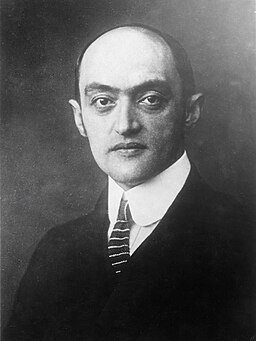
An Austrian who died 75 years ago knew a lot about foundation research
Understand their priorities, not just their program areas.
One of my favorite quotes is from Joseph Schumpeter, “The budget is the skeleton of the state, stripped of all misleading ideologies”.
Or more simply, as Joe Biden put it, “Show me your budget and I’ll tell you what you value.”
Invest time where you're positioned to win.
This is the hardest part of REVEAL. It means saying NO to low probability opportunities and investing more in high probability ones.
Most nonprofits do the opposite: they chase everything and win little.
Before writing any proposal (or even an LOI), I ask three questions:
Does this funder's actual grant history show they fund organizations like us? (Organizations with our structure, approach, budget size, and philosophy.)
Does their language match our language? (If they emphasize clinical care and we emphasize peer support, that's a mismatch.)
Can we make a unique, credible case for why WE should win this? (Our differentiators.)
If you can't answer yes to all three, don't apply. Save your time for opportunities where you're genuinely positioned to win.
ANALYZE is about knowing yourself. REVEAL is about knowing your donors.
Analyze
When I was in my 20s, I spent a lot of my time in nonprofit offices, figuring out their challenges, facilitating strategic planning, or discussing fundraising strategies. I liked to ask executive directors, “who are your competitors?”
The answer was always the same “Oh, we don’t have competitors” OR “Oh I don’t really know.” Nonprofits are too nice.
It’s ok to acknowledge that you compete for the same dollars and that there are things that make you better than your competition. It’s even better to get specific.
What makes your organization compelling? It’s four things.
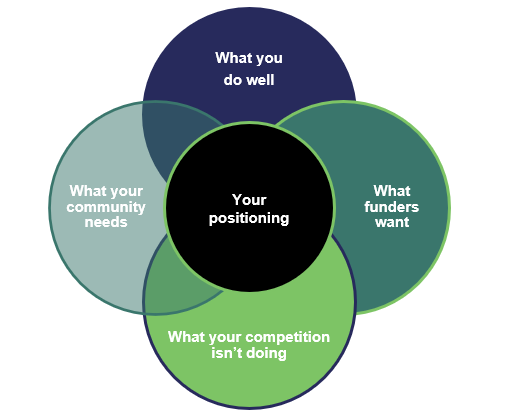
1. What you do well
Everyone can say they provide 'evidence-based mental health services.' That means nothing.
What you need is something like: 'We use peer-led navigation where people with lived experience of mental health challenges deliver services. Our data shows 3x higher engagement rates and 78% appointment adherence compared to 24% with traditional clinical outreach.'
Specific and measurable. Impossible for a competitor to copy-paste.
2. What funders want
You might do amazing work, but if funders are going in a different direction, you're running the steeplechase (look it up!), while everyone else gets to stay dry.
Look at donor 990s. Read their annual reports. Pay attention to their language.
If every foundation in health equity is talking about 'community-driven solutions' and 'centering lived experience,' but your model is clinical and provider-led, you have a positioning problem.
You can either reframe your work to show how it aligns with what funders want, or find different funders who value what you actually do. Both are valid strategies. What doesn't work is ignoring what funders care about.
3. What your competition isn’t doing
When I was at RTI, our major health governance competi-peer focused heavily on online training, tools, and cross-country cohorts.
We went the other direction. Bespoke models, strong political economy analysis, and in-depth expert analysis and advice. That approach didn’t scale quite as well, but we didn’t want scale. We wanted impact.
Zig when others zag, I say. Fill a gap. Find your niche.
4. What your community needs
I mentioned political economy analysis earlier: that’s one way to identify your community needs, and the drivers behind the challenges your community faces. Being able to say that you analyzed the data, talked to people, and understand not just how things work, but WHY they work, is often the difference between a credible, winning proposal, and one that doesn’t quite get across the finish line.
This isn’t a proposal story, but it’s indicative. I once launched a project thinking I was building an IT solution to help a government agency better manage its workflow. I was wrong. After talking to the community they served, I realized that the problem wasn’t a technology one, it was trust. So we pivoted the project to support trust building between the agency and their clients, driving service usage from 1 or 2 cases a month to dozens.
ANALYZE isn't about writing your mission statement better or more clearly. It's about an honest self, community, donor, and competitive assessments. What do we do better than anyone else? What do funders actually care about right now? What gaps exist in how our competitors serve communities? What does our community need that they're not getting?
Next up: REVEAL. How do you find funders who actually care about that difference?
Introducing ARCH
Most nonprofits treat grant development like a sprint.
They see an RFP and take off running at full speed. A fury of activity commences and five minutes before the deadline, they hit submit…breaking the tape just in time.
Then they stop running and wander around the track aimlessly, with their hands on their heads.
A month or two, or sometimes 24 goes by, and an award notification (or loss letter :/) comes, and it all begins again. No learning; no growth. Just motion.
But growth isn’t a sprint. It’s a marathon. 20,000 steps in a repeatable, defined order, while closely managing effort.
One of my favorite running quotes is, “A runner is a miser, spending the pennies of his energy with great stinginess.”
Growth is similar. We expend our energy wisely. Each activity needs a purpose.
In 20 years at nonprofits, I helped raise over $400M for health, nutrition, and governance programs, all without working too many weekends, and revising my application for the 27th time.
We had a systematic approach that I’ve adapted to help nonprofits structure their grant development. I call it ARCH:
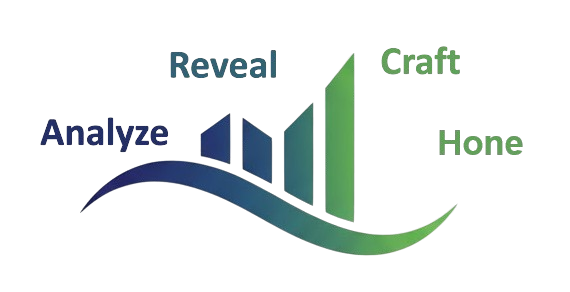
ANALYZE - Understanding what makes your organization different
REVEAL - Identifying donor and community needs and how to frame impact
CRAFT - Writing proposals that inspire
HONE - Learning from every proposal
Most nonprofits skip straight to CRAFT. Find RFP, write response, repeat. Beautiful proposals that chase the wrong funders, highlighting programs that don't differentiate them.
Over the next few weeks, I'm breaking down each piece of ARCH: what it is, why it matters, how to use it.
First up: ANALYZE. What makes your organization genuinely different? Why YOU?
As my uncle would say, it helps to think like an investor, not a do-gooder.
Foundation Search
I thought most nonprofits would have a pipeline of grants they were ready to write. I’d come in and help them figure out an approach, think through how they’d execute it, develop some strong alignment with donor missions, and write some high-quality grants.
Fun fact: No.
Discussions typically start with “we do cool thing x, y, and z; can you help us find funding for our cool things?”
Which, cool things are awesome…but I can think of a lot of cool things that never attract funding.
So, I looked at a number of foundation search options. GrantStation? Expensive. Grantseeker.io? Expensive. Candid? Very expensive.
As it turns out, most of these databases are just a fancy UI around public (inscrutable, but yes, public) IRS Form 990s.
Cue these organizations yelling at me “but we provide AI writing tools, bespoke integration, and checklists!!!” Nah, everyone uses them for donor research.
So uh, instead of paying for this, I downloaded all the 2025 IRS Form 990s from the IRS website. Now these are just text documents that you can only read in Notepad. They aren’t searchable, they aren’t cleaned, etc. The IRS just dumps them out on their website.
100,000s of nonprofits. Millions of rows. BUT, I just need the foundations, not every nonprofit in the country. So I figure out the python code to sort them. 25,000! That’s manageable. However…
I know nothing. I think I can just upload all these to copilot and tell it to search them.
Nope, wrong. That doesn’t work. AI doesn’t search like google. It takes chunks and outputs a “plausible answer”. That won’t fly.
Build a csv file with all the data? Millions upon millions of rows. Computer crashes.
Create thousands of csv files with the data? Still not searchable. Oh, and it lost critical data because the text files aren’t regularly formatted.
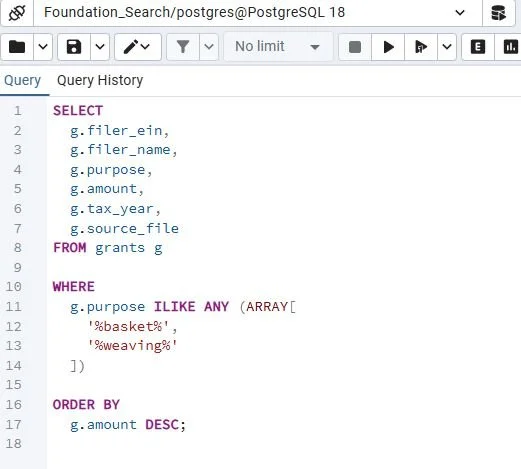
So then I create a single csv file with only the fields that I selected from these text files, and this morning I loaded it into Postgres.
Success!
Now I can query every single grant made by a foundation that filed with the IRS in 2025.
Long story short, private foundations gave over 600,000 grants last year.
If you are one of the 62 private foundations that gave grants related to basket weaving last year, it’s in my database. Perhaps you’d like to fund more basket weaving work?
And if you have a nonprofit and would like to know which foundations fund organizations like yours, reach out. Have I got a database for you.
Effective Writing
Who, what, when, where, why. The 5 Ws. Everyone knows them.
These are the basic questions to analyze the critical details of any story.
What is a proposal, if not a story?
It’s a story of who we are and where we want to go. In a proposal, we are asking someone else, another organization, to take that journey with us.
To win funding, you need to clearly explain:
WHO you are.
WHAT you do.
WHEN you do the work.
WHERE you work.
WHY you exist.
To these five questions, add three more: HOW you work, your RESULTS, and SO WHAT.
You can use this framework to write a description of your organization, a project summary, and yes, a grant proposal.
Let’s say we want to create an acute care community health outreach project in Tanzania. It would look like this:
(Why/so what) Emergency care is unavailable in rural areas, and most people live far from hospitals. By collaborating with community health workers to learn first aid and develop locally-appropriate transportation plans to hospitals, people in rural areas are stabilized and moved to hospitals with emergency care, improving their health outcomes.
(When/who/where/what) With your foundation’s help, Cadence Advisory will collaborate with district health staff, health facility leadership, and local organization X in Singida Rural District to train 120 community health workers on emergency first aid, job aids, first aid kits, and transportation information to strengthen access to emergency care.
(How) Cadence will train CHWs in an intensive one-week course held by our Clinical Officer. Topic areas include bleeding control, splints, stabilization, safe transport, and equipment use using WHO-approved tools and job aids. Our Clinical Officer will conduct quarterly mentoring visits with each CHW to check quality of care, knowledge, and troubleshoot challenges.
(Results) The 120 trained CHWs will provide first aid and safe transport for 1,000 people in the first year.
This framework seems easy. But everyone wants to explain the “what”. The gap is explaining the “how”.
Funders want to know that you understand how to carry out the work, not just that you understand the why and the what.
New Beginnings
One thing they don't tell you about starting something new: You get to be your own IT Director, Finance Director, Ops Manager, Technical Advisor, and BD Director! And yet, you also HAVE to be all of those things.
For example, which CRM platform should you use? Salesforce is too built out for what I need, but there's at least 5-6 others I could use. How do you decide?
Accounting software? Quickbooks, yes? Also an expensive subscription. There are a variety of other free/low cost options depending on what you need, with different tiers and products.
Bank? Local credit union or giant conglomerate. Benefits and downsides to both!
Cloud services? Microsoft? Google? AWS?
Meeting platform? Teams? Google Meet? Zoom?
Invoicing and billing? Wave, Zelle, and Melio are all options with varying fees and structures, especially if you're invoicing small NGOs rather than large government contractors.
Some of these systems integrate with each other. Some don't.
Each of these choices lock you into a particular ecosystem and if they don't talk to each other, now you've made your life harder rather than easier.
So if you ever wonder why every large government contractor just uses whatever terrible thing Oracle developed, I get it now. Path dependency and integration...UX be damned.
Welcome to my Ted Talk. :)
Blogs will go here!
Thoughts on organizational growth, nonprofit funding, and public health.
My blog will feature thoughts on organizational growth, grant writing and public health. In the meantime, please find my old Medium account here.